
About
About STEMPA
Accelerating Research. Empowering Progress.
A Framework That Moves
Research Forward
STEMPA (Shorten Time to Execute Multi-party Project Agreements) is an ecosystem-wide initiative designed to accelerate multi-party project agreements for major publicly funded research programmes under the Human Health and Potential (HHP) domain.
STEMPA is founded on the recognition that effective research collaboration depends not only on strong science, but also on clear, timely and consistent agreement-making across institutions. It reflects a shared commitment by participating institutions to approach collaboration with greater alignment, predictability, and mutual understanding, particularly in complex projects involving multiple parties.
By anchoring collaboration on common expectations and principles, STEMPA aims to support smoother engagement between institutions and enable research projects to move forward with greater confidence and momentum.
Scope of STEMPA
STEMPA applies to selected public sector research grants under the Human Health and Potential domain. Effective from FY2026 under RIE2030:

In Scope
- NMRC Open Fund Large Collaborative Grant
- HHP MISSION Stream 1

Not Covered
- Agreements involving private or industry partners
- Agreements involving foreign institutions
- Clinical trial agreements
Projects with Multiple Agreements
For projects involving multiple agreements, STEMPA applies only to the in-scope public sector agreements.
From Approval to Funding: The STEMPA Journey
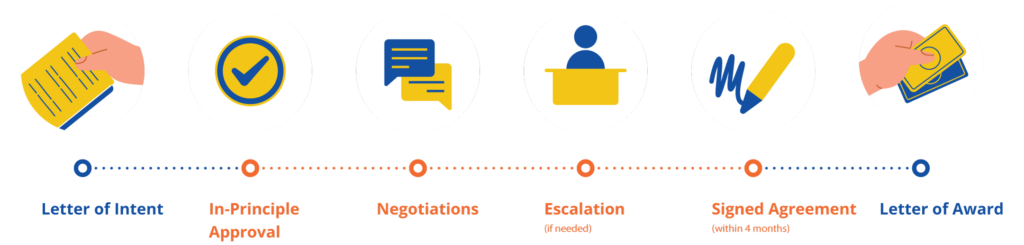
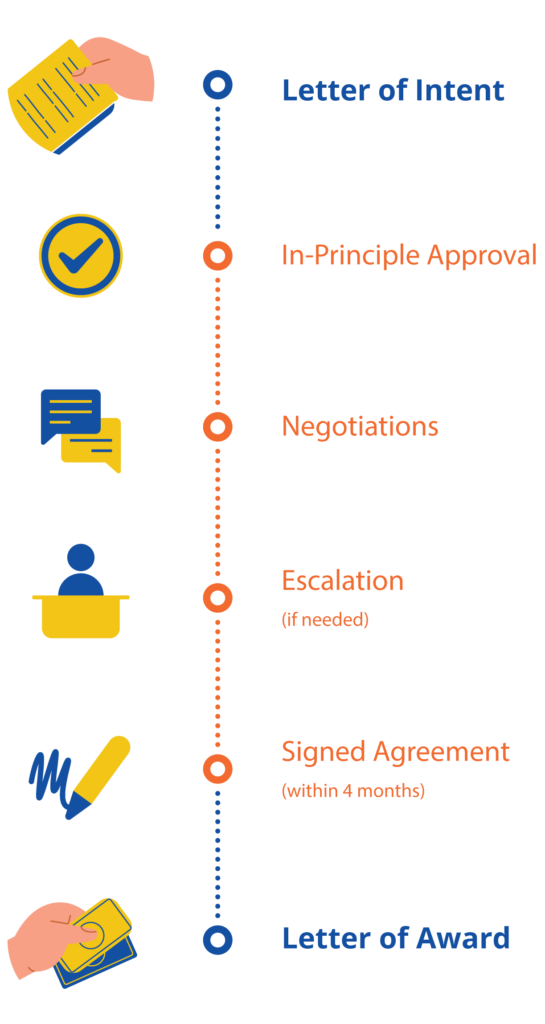
STEMPA defines a clear pathway from proposal to funding. Following in-principle approval of the grant, negotiations for in-scope project agreements proceed within a defined four-month timeline. Once all in-scope agreements are submitted, funding can be released, allowing projects to proceed in accordance with grant and institutional requirements.
What We’ve Standardised Upfront
STEMPA provides a structured approach for participating institutions to work through project agreements efficiently. It does so by encouraging a shared approach to project agreement discussions and negotiations, and involves:
- Clarification of roles and responsibilities during negotiations
- Suggested meeting cadence to maintain momentum
- Early identification of issues that are likely to require alignment
- Encouragement of parallel discussions where appropriate
Alongside this shared approach, STEMPA has also established aligned positions and reference points for a defined set of commonly recurring agreement-level matters outlined below:
Foreground IP Ownership
STEMPA-aligned Position: Foreground intellectual property ownership is determined solely by inventive contribution.
- This position is aligned with international guidelines, Singapore’s National Intellectual Property (IP) Protocol, and the Public Sector Master Research Collaboration Agreement (PS MRCA).
- The PS MRCA Factsheet in Healthcare provides clarity on what constitutes inventive and non-inventive contributions, and is included as an annex to the STEMPA Guidebook.
Revenue Sharing From Commercialisation of FIP
STEMPA-aligned Position: Revenue Sharing from Commercialisation of Foreground Intellectual Property (FIP)
- Contributions that are inventive and non-inventive are recognised for revenue sharing arising from the commercialisation of FIP.
Data Ownership
STEMPA Pre-Aligned Position: Ownership of data is determined by who collects, generates, and/or enhances it.
- Parties own the data they collect, generate, and/or enhance.
- Non-owners — parties who do not undertake ownership-conferring activities — retain access rights to the data or datasets arising directly from their contributions.
- Data ownership principles, including the threshold for ownership-conferring activities, are set out in the STEMPA Guidebook and its annexed Data Collaboration Dictionary.
Data Sharing Governance & Controls
STEMPA references the Data Sharing Guidebook as a common resource to support a shared understanding of data sharing governance and practices across public healthcare institutions.
Data Responsibilities & Incident Resolution
STEMPA-aligned Position: There are no contractual data-related indemnities, warranties, or liability caps. Instead, data-related risks and incidents are managed through clearly defined data handling responsibilities and established incident resolution and escalation pathways.
- Project agreements do not include data-related warranties, indemnities, or liability caps.
- Data-related responsibilities are delineated for key data roles, including data contributors, data users, and data custodians, through the Data Responsibilities Framework.
- A structured pathway is established for resolving data-related incidents, including data breaches, based on clearly defined roles, responsibilities, and escalation pathways.